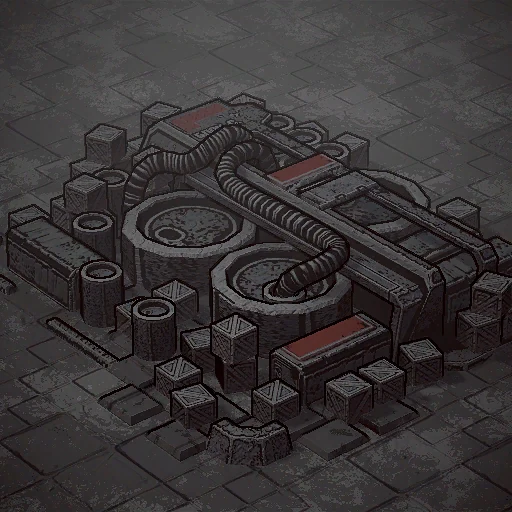
Use the current settings below when comparing this entity. The earlier text and its tactical conclusions remain historical; their values are not assigned to this build.
Greatly increases supply limits. Useful for faster deployment and better suited for late-stage conflicts.
Requirements / Minerals
350
Requirements / Energy
5
Requirements / Gears
40
Requirements / Production time, seconds
20.0
Production / Population
180
Production / Storage
50
Defence / Base hit points
1200
Defence / Extra capacity
50
Defence / Front armour
5
Defence / Side and rear armour
5
Defence / Directional armour flag
no
Defence / Fire resistance value
0.30000001192092896
Defence / Gas resistance value
0.8999999761581421
Defence / Area resistance value
0.15000000596046448
Defence / Total hit-point capacity
1250
Producers / 1
Supply depot
Some parameters and links remain uncertain. A missing value here does not establish absence of a game mechanic.
Compare the relevant cost, defence or support settings before applying an older recommendation. File settings do not establish battle results or a guaranteed counter.
Unreadable objects and an unresolved ability link prevent treating this as a complete measurement of every mechanic.
The previous comparison is retained below — build 26004785. The following dates and values belong to their own source.
Revision for the installed demo: Large warehouse
Current records — build 26004785
The current records below replace the older values for the same entity. The earlier text is retained separately as a historical version; its numbers and tactical conclusions are not claims about this version.
Greatly increases supply limits. Useful for faster deployment and better suited for late-stage conflicts.
Purchase and production requirements
Minerals: 350
Energy: 5
Gears: 40
Production time, seconds: 20
Production and capacity
Population: 180
Storage: 50
The earlier geometric dimensions or changed scene bindings have not been re-established as equivalent measurements. Do not use the older footprint as a placement rule for this version. This uncertainty does not mean the game lacks the feature.
When choosing or using this entity, compare the current settings shown here with the situation in your demo. File values alone do not measure battle results, simultaneous ability activity or a guaranteed counter. Earlier advice that depends on changed values remains historical until checked again.
The historical edition is retained below — build 23882143. Its earlier values must not be carried into the current version.
The historical edition is retained below — build 23882143
The Large warehouse costs 250 minerals, 5 energy and 20 gears. It adds 90 supply and 100 storage; the Mat. Fabricator also adds both, at 50 supply and 200 storage. The Warehouse description says “Greatly increases supply limits. Useful for faster deployment and better suited for late-stage conflicts.” Build 23882143 records 1 200 base hit points. These figures describe different roles and budgets rather than a universal upgrade path. Its linked footprint is larger than the small Warehouse’s, so account for space and producer access when expanding the supply network.
Gears are part of several separate purchases: the Large warehouse needs 20, the Arsenal 100, the Foundry 100, and the Dreadnought description says “Super-heavy artillery. An indispensable vehicle for defense, fortification, and prolonged siege of enemy lines. In mobile mode, it can support the offensive.” Its gear price is 50. That comparison does not prove gears are scarce on every map or that these purchases form a fixed technology order. The Large warehouse’s description gives a late-conflict role, while its supply and storage fields explain what it adds. Read the demo guide for the playable army selection and the economy guide before assigning a campaign role to a configuration simply because it has a gear price.
The Large warehouse costs 250 minerals and adds 90 supply, with an energy requirement of 5 and gear cost of 20. The small Warehouse costs 120 minerals and adds 20 supply; the large building also adds 100 storage. Compare these recorded effects without inventing a mandatory switch point from a mineral ratio. Space, construction time and the producer may decide which purchase fits now. Use the economy guide to plan the next army orders and keep material capacity separate from supply capacity.
The phrase “late-stage conflicts” describes the intended role, not a rule that forbids an earlier purchase. The building requires 20 gears and adds 90 supply, so compare that commitment with the units and other infrastructure you need. Its 1 200 base hit points do not by themselves make it a poor raid target. Consider whether the opponent needs its supply or storage and what protects the approach. For the defender, avoid buying capacity you cannot use yet; the economy guide provides the relevant resource distinctions.
Confirmed Established — fromdocs/sources/demo/raw/BuildConfig.json / r_BarnBig_Build, build 23882143
Cost
Minerals
250
Energy
5
Gears
20
Build time
20 s
Defence
Hit points
1 200
Extra hit points
+50
Armour
5
Fire resistance
0.3
Gas resistance
0.9
Area resistance
0.15
What it is
The Large warehouse costs 250 minerals, 5 energy and 20 gears. It adds 90 supply and 100 storage; the Mat. Fabricator also adds both, at 50 supply and 200 storage. The Warehouse description says “Greatly increases supply limits. Useful for faster deployment and better suited for late-stage conflicts.” Build 23882143 records 1 200 base hit points. These figures describe different roles and budgets rather than a universal upgrade path. Its linked footprint is larger than the small Warehouse’s, so account for space and producer access when expanding the supply network.
Where it comes from
Gears are part of several separate purchases: the Large warehouse needs 20, the Arsenal 100, the Foundry 100, and the Dreadnought description says “Super-heavy artillery. An indispensable vehicle for defense, fortification, and prolonged siege of enemy lines. In mobile mode, it can support the offensive.” Its gear price is 50. That comparison does not prove gears are scarce on every map or that these purchases form a fixed technology order. The Large warehouse’s description gives a late-conflict role, while its supply and storage fields explain what it adds. Read the demo guide for the playable army selection and the economy guide before assigning a campaign role to a configuration simply because it has a gear price.
How it is actually used
The Large warehouse costs 250 minerals and adds 90 supply, with an energy requirement of 5 and gear cost of 20. The small Warehouse costs 120 minerals and adds 20 supply; the large building also adds 100 storage. Compare these recorded effects without inventing a mandatory switch point from a mineral ratio. Space, construction time and the producer may decide which purchase fits now. Use the economy guide to plan the next army orders and keep material capacity separate from supply capacity.
How to beat it
The phrase “late-stage conflicts” describes the intended role, not a rule that forbids an earlier purchase. The building requires 20 gears and adds 90 supply, so compare that commitment with the units and other infrastructure you need. Its 1 200 base hit points do not by themselves make it a poor raid target. Consider whether the opponent needs its supply or storage and what protects the approach. For the defender, avoid buying capacity you cannot use yet; the economy guide provides the relevant resource distinctions.