Weapons · 3
| Family | Fire cycle | Damage per second |
|---|---|---|
| Projectile | 4.65 s | 64.5 vs infantry · 53.8 vs vehicles · 21.5 vs buildings |
| Projectile | 4.65 s | 64.5 vs infantry · 53.8 vs vehicles · 21.5 vs buildings |
| Projectile | 4.65 s | 64.5 vs infantry · 53.8 vs vehicles · 21.5 vs buildings |
Damage per second = damage ÷ fire cycle, computed by the build script.
What it is
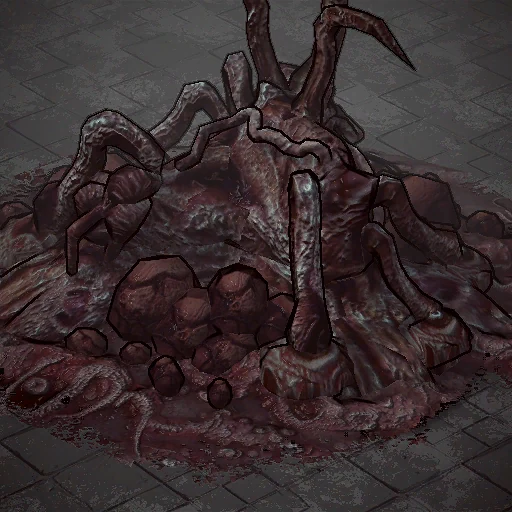
A pool of flesh mass has 8 000 base hit points and a 50-point reserve capacity. The official description gives its role: “A large building that nurtures a gigantic mutant. In its static form, it functions as long-range artillery, very difficult to ignore on the battlefield.” Three attached projectile components each record 300 damage against infantry, 250 against vehicles and a 4.65-second extracted cycle. Their calculated rates are 64.5 and 53.8 respectively. Armour is 15 in build 23882143. The construction price fields are zero; that does not prove unrestricted availability. Identical attached weapons also do not establish simultaneous firing or a combined damage rate.
Where it comes from
The Giant’s extracted weapon also records 300 infantry damage, 250 vehicle damage and a 4.65-second cycle. This is a comparison of weapon parameters in build 23882143, not proof that the building fires all of its attached weapons together. The Pool’s area coefficient is −0.2; it is not a faction-wide splash rule. The description says the building nurtures a giant mutant, but the linked records examined here do not establish a conventional production queue for the Giant. Keep that stated role distinct from a proven command, transformation or reinforcement schedule.
How it is actually used
Its attached projectile weapons give a calculated infantry rate of 64.5 per component. Do not add those rates into a guaranteed wall of fire without evidence of simultaneous activation. The combined health capacity is 8 050, with armour 15; the reserve’s initial state must remain distinct from its capacity. Its four-tile minimum range is a placement constraint, not a safe zone against all neighbouring defenders. Use the Pool’s static-artillery role to organise overlapping coverage, while keeping the description’s giant-nurturing role separate from an assumed production button.
How to beat it
The Pool’s combined health capacity is 8 050, so assess the force and time you can actually commit rather than declaring every direct attack a losing race. Its area coefficient −0.2 does not prove increased artillery damage or determine the effectiveness of other responses. Vehicle damage of 250 belongs to each recorded projectile component; tripling it would assume simultaneous fire. The four-tile minimum range can influence the approach, but reaching it is not proof of safety from supporting units. Compare the firing position and nearby defence before choosing whether to attack, bypass or isolate this structure.
Values read from game files · version 23882143