Skip to content
Dust Front RTS Guide
Menu

Artillery and spotters: current settings: Artillery and spotters: current settings

Checked: — build 26104922

The artillery and forced-fire settings have changed. Compare the current minimum and maximum ranges and purchase requirements rather than carrying the old examples into this build. The archived developer description explains the earlier design; it is not a new battle test.

Requirements / Minerals
800
Requirements / Gears
50
Requirements / Population
75
Requirements / Production time, seconds
90.0
Defence / Base hit points
1800
Defence / Extra capacity
60
Defence / Front armour
8
Defence / Side and rear armour
8
Defence / Directional armour flag
yes
Defence / Fire resistance value
1.0
Defence / Gas resistance value
1.0
Defence / Area resistance value
0.5
Defence / Total hit-point capacity
1860
Weapons / 1 / Weapon family
Projectile
Weapons / 1 / Range
81.37800598144531
Weapons / 1 / Range bonus
65.0
Weapons / 1 / Minimum range
22.0
Weapons / 1 / Reload, seconds
6.0
Weapons / 1 / Aiming time, seconds
0.30000001192092896
Weapons / 1 / Firing on the move
yes
Weapons / 1 / Damage / Infantry
50
Weapons / 1 / Damage / Vehicles
200
Weapons / 1 / Damage / Buildings
0
Weapons / 1 / Firing cycle, seconds
6.3
Weapons / 1 / Calculated damage per second / Infantry
7.9
Weapons / 1 / Calculated damage per second / Vehicles
31.7
Weapons / 1 / Calculated damage per second / Buildings
0.0
Activation / Reload, seconds
1.0
Activation / Minimum range
22
Activation / Maximum range
95

Some parameters and links remain uncertain. A missing value here does not establish absence of a game mechanic.

Unreadable objects and an unresolved ability link prevent treating this as a complete measurement of every mechanic.

The historical text is retained below — build 23882143. The following dates and values belong to their own source.

The historical edition is retained below — build 23882143

Artillery and spotters: the ultimatum force, and how it is actually aimed

The developer calls artillery “a kind of ultimatum force” and names exactly three answers to it. Past a certain range it cannot aim on its own — a squad of spotters does it, and that squad is the most fragile link in the chain.

Artillery is the system the developer has explained most carefully, and he set out its role in a single sentence on 10 February 2026: it “acts as a kind of ultimatum force, which can be eliminated either with excessive losses (depends on composition of the army), other artillery counter-fire, or aircraft from tactical support abilities.” That is a complete list of counters, given by the person who wrote the system. The developer lists no fourth answer in that passage.

The mechanical detail behind it explains why artillery is not simply a long-ranged gun. Past its own auto-attack range the weapon changes how it fires: “the shells fly along a more curved trajectory and with a greater spread.” Reaching further costs you accuracy, and the game charges that cost automatically rather than asking you to choose.

Beyond that, artillery stops aiming for itself. “For beyond ranges, artillery uses a squad of spotter artillerymen” — and once the correction is finished, “The free artillery with the required mode will immediately aim at the target after correction is completed.” The word to notice is “free”: guns already firing at something else do not drop it. Idle guns take the target instantly.

The spotters are worth a paragraph of their own, because their statistics are the strangest in the demo. They deal 400 damage to infantry and 10 to vehicles — a ratio of forty to one, the most extreme in the entire catalogue. The developer describes them as artillerymen “Who are also snipers at the same time,” and the numbers agree: against infantry they are devastating, against anything armoured they are useless.

They are also thin. 350 hit points behind 2 armour makes them one of the most fragile squads in the Empire roster, and the man who actually carries the guidance kit is the first in the squad to die. Losing your correction does not require losing the unit — it requires scratching it.

The heaviest guns are wired to this the same way: “Heavy Dreadnoughts fire at long range guided by the spotters.” A Dreadnought without a spotter is an expensive short-ranged vehicle.

The practical conclusion is unglamorous. Artillery in Dust Front is a two-unit system, and the cheap half is the half that breaks. Escort the spotters as carefully as you escort the guns, and remember what the developer listed first among the counters: your opponent will accept excessive losses to reach them.

Quotations from the announcement of 10 February 2026; statistics read from build 23882143.

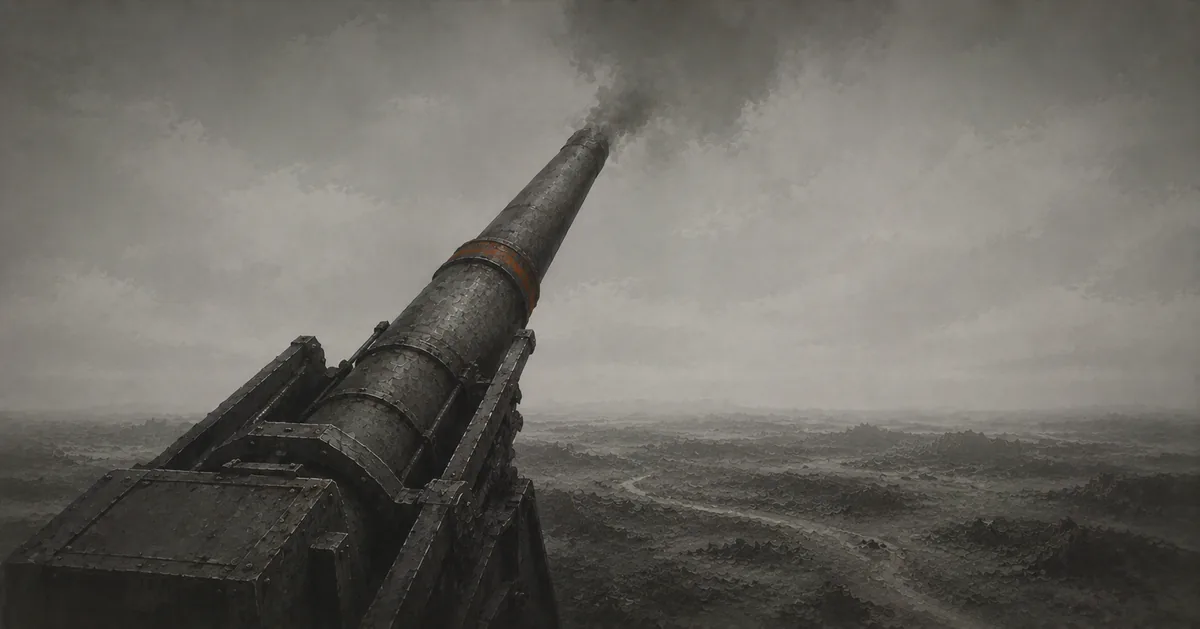
Original artwork for Artillery and spotters: current settings — ⛔ an illustration made for this site, not a screenshot of the game

Artillery and spotters: current settings

The developer calls artillery “a kind of ultimatum force” and names exactly three answers to it. Past a certain range it cannot aim on its own — a squad of spotters does it, and that squad is the most fragile link in the chain.

Confirmed Updated · numbers from version 23882143

Original artwork made for this site — not a screenshot of the game

Artillery is the system the developer has explained most carefully, and he set out its role in a single sentence on 10 February 2026: it “acts as a kind of ultimatum force, which can be eliminated either with excessive losses (depends on composition of the army), other artillery counter-fire, or aircraft from tactical support abilities.” That is a complete list of counters, given by the person who wrote the system. The developer lists no fourth answer in that passage.

The mechanical detail behind it explains why artillery is not simply a long-ranged gun. Past its own auto-attack range the weapon changes how it fires: “the shells fly along a more curved trajectory and with a greater spread.” Reaching further costs you accuracy, and the game charges that cost automatically rather than asking you to choose.

Beyond that, artillery stops aiming for itself. “For beyond ranges, artillery uses a squad of spotter artillerymen” — and once the correction is finished, “The free artillery with the required mode will immediately aim at the target after correction is completed.” The word to notice is “free”: guns already firing at something else do not drop it. Idle guns take the target instantly.

The spotters are worth a paragraph of their own, because their statistics are the strangest in the demo. They deal 400 damage to infantry and 10 to vehicles — a ratio of forty to one, the most extreme in the entire catalogue. The developer describes them as artillerymen “Who are also snipers at the same time,” and the numbers agree: against infantry they are devastating, against anything armoured they are useless.

They are also thin. 350 hit points behind 2 armour makes them one of the most fragile squads in the Empire roster, and the man who actually carries the guidance kit is the first in the squad to die. Losing your correction does not require losing the unit — it requires scratching it.

The heaviest guns are wired to this the same way: “Heavy Dreadnoughts fire at long range guided by the spotters.” A Dreadnought without a spotter is an expensive short-ranged vehicle.

The practical conclusion is unglamorous. Artillery in Dust Front is a two-unit system, and the cheap half is the half that breaks. Escort the spotters as carefully as you escort the guns, and remember what the developer listed first among the counters: your opponent will accept excessive losses to reach them.

Quotations from the announcement of 10 February 2026; statistics read from build 23882143.

Values read from game files · version 23882143

← All guides