Skip to content
Dust Front RTS Guide
Menu

Updated demo records: Dreadnought "Howitzer"

Checked: — build 26104922

Use the current settings below when comparing this entity. The earlier text and its tactical conclusions remain historical; their values are not assigned to this build.

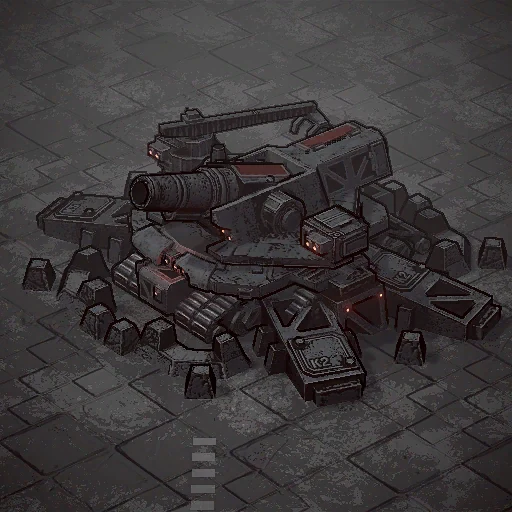
Super-heavy artillery. The most powerful cannon that can be freely moved around the battlefield.

Requirements / Minerals
800
Requirements / Gears
50
Requirements / Population
75
Requirements / Production time, seconds
90.0
Equipment slots
3
Defence / Base hit points
1800
Defence / Extra capacity
60
Defence / Front armour
8
Defence / Side and rear armour
8
Defence / Directional armour flag
yes
Defence / Fire resistance value
1.0
Defence / Gas resistance value
1.0
Defence / Area resistance value
0.5
Defence / Total hit-point capacity
1860
Weapons / 1 / Weapon family
Projectile
Weapons / 1 / Range
81.37800598144531
Weapons / 1 / Range bonus
65.0
Weapons / 1 / Minimum range
22.0
Weapons / 1 / Reload, seconds
6.0
Weapons / 1 / Aiming time, seconds
0.30000001192092896
Weapons / 1 / Firing on the move
yes
Weapons / 1 / Damage / Infantry
50
Weapons / 1 / Damage / Vehicles
200
Weapons / 1 / Damage / Buildings
0
Weapons / 1 / Firing cycle, seconds
6.3
Weapons / 1 / Calculated damage per second / Infantry
7.9
Weapons / 1 / Calculated damage per second / Vehicles
31.7
Weapons / 1 / Calculated damage per second / Buildings
0.0
Linked by the demo battle setup
yes

Some parameters and links remain uncertain. A missing value here does not establish absence of a game mechanic.

Compare the relevant cost, defence or support settings before applying an older recommendation. File settings do not establish battle results or a guaranteed counter.

Unreadable objects and an unresolved ability link prevent treating this as a complete measurement of every mechanic.

The historical text is retained below — build 23882143. The following dates and values belong to their own source.

The historical edition is retained below — build 23882143

Dreadnought “Howitzer” costs 700 minerals, 50 gears and 50 population, with 90 seconds of construction. Its description calls it “The most powerful cannon that can be freely moved around the battlefield.” The catalogue attack fields record 50 infantry and 200 vehicle damage on a calculated 6.3-second cycle, yielding 7.9 and 31.7 per second. A zero building field does not prove zero total damage: the raw attack also has a clean-damage field and a linked explosion. Base health is 1 200, frontal armour 30 and side/rear armour 10 in build 23882143. Check the payload and siege state before choosing a target from the shortened damage table.

In build 23882143, this configuration is linked to the Dreadnought’s local Siege cannon replacement. The projectile attack has a separate clean-damage field, while its projectile record names an explosion key. A building-category field of zero is therefore insufficient to declare the whole weapon harmless to structures. Siege-state actions also enable and disable the attack. These are configuration links, not a chronology of balance changes or a complete damage formula. Read the Siege cannon and Siege mode pages alongside the payload before treating identical prices as a simple pair of independently purchased weapons.

The calculated category outputs are 31.7 damage per second against vehicles and 7.9 against infantry. They omit the separate clean-damage field, so they cannot establish that the weapon is useful only against vehicles or harmless to buildings. Rear armour is 10 on a chassis whose listed mineral price is 700. Check the local replacement path and current siege state before committing it to fire. Its minimum range and payload matter alongside target protection; the linked explosion key needs care when interpreting the shortened weapon table. The Siege cannon page explains how this configuration relates to Dreadnought.

Do not assume infantry is safe because the category field is 50 damage per shot on a 6.3-second cycle. Other damage fields and the linked explosion remain part of the weapon’s data. A close approach also needs to consider minimum range, the active mode and nearby defenders; it is not immunity to the entire enemy position. The area-resistance coefficient is 0.6, without a documented conversion to reduced splash damage. Compare the actual projectile and armour rather than declaring flame, infantry or artillery a universal counter. Siege mode and the payload are the useful next references.

Dreadnought "Howitzer" — Updated demo records as it appears in the Dust Front RTS demo, from the game files of build 23882143

Dreadnought "Howitzer" — Updated demo records

Confirmed Established — fromdocs/sources/demo/raw/UnitConfig.json / r_Bombarda_Unit, build 23882143

Cost

Minerals
700
Gears
50
Population
50
Build time
90 s

Defence

Hit points
1 200
Extra hit points
+60
Front armour
30
Sides-and-rear armour
10
Fire resistance
0.9
Gas resistance
0.9
Area resistance
0.6

Weapons · 1

FamilyFire cycleDamage per second
Projectile6.3 s7.9 vs infantry · 31.7 vs vehicles · 0 vs buildings

Damage per second = damage ÷ fire cycle, computed by the build script.

What it is

Dreadnought “Howitzer” costs 700 minerals, 50 gears and 50 population, with 90 seconds of construction. Its description calls it “The most powerful cannon that can be freely moved around the battlefield.” The catalogue attack fields record 50 infantry and 200 vehicle damage on a calculated 6.3-second cycle, yielding 7.9 and 31.7 per second. A zero building field does not prove zero total damage: the raw attack also has a clean-damage field and a linked explosion. Base health is 1 200, frontal armour 30 and side/rear armour 10 in build 23882143. Check the payload and siege state before choosing a target from the shortened damage table.

Where it comes from

In build 23882143, this configuration is linked to the Dreadnought’s local Siege cannon replacement. The projectile attack has a separate clean-damage field, while its projectile record names an explosion key. A building-category field of zero is therefore insufficient to declare the whole weapon harmless to structures. Siege-state actions also enable and disable the attack. These are configuration links, not a chronology of balance changes or a complete damage formula. Read the Siege cannon and Siege mode pages alongside the payload before treating identical prices as a simple pair of independently purchased weapons.

How it is actually used

The calculated category outputs are 31.7 damage per second against vehicles and 7.9 against infantry. They omit the separate clean-damage field, so they cannot establish that the weapon is useful only against vehicles or harmless to buildings. Rear armour is 10 on a chassis whose listed mineral price is 700. Check the local replacement path and current siege state before committing it to fire. Its minimum range and payload matter alongside target protection; the linked explosion key needs care when interpreting the shortened weapon table. The Siege cannon page explains how this configuration relates to Dreadnought.

How to beat it

Do not assume infantry is safe because the category field is 50 damage per shot on a 6.3-second cycle. Other damage fields and the linked explosion remain part of the weapon’s data. A close approach also needs to consider minimum range, the active mode and nearby defenders; it is not immunity to the entire enemy position. The area-resistance coefficient is 0.6, without a documented conversion to reduced splash damage. Compare the actual projectile and armour rather than declaring flame, infantry or artillery a universal counter. Siege mode and the payload are the useful next references.

Values read from game files · version 23882143

← All units