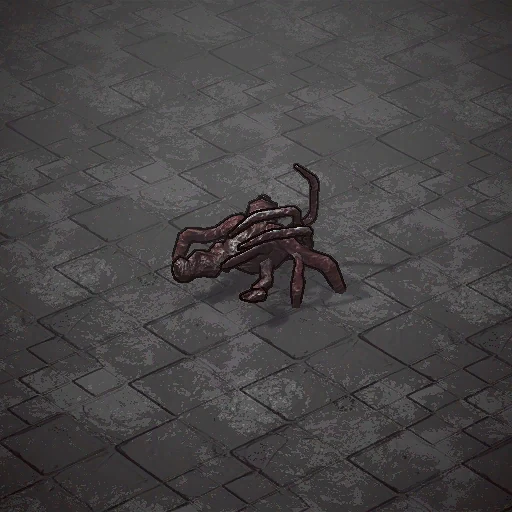
Weapons · 1
| Family | Fire cycle | Damage per second |
|---|---|---|
| Cannon | 4.5 s | 66.7 vs infantry · 35.6 vs vehicles · 15.6 vs buildings |
Damage per second = damage ÷ fire cycle, computed by the build script.
What it is
The Spider costs 130 minerals and 15 population, with a twenty-six-second production time. Its official description gives a specific role: “Technically not a spider, but nicknamed so because of its thin legs. Very fast and effective against vehicles. Excellent for flanking. Almost no durability.” Build 23882143 records 560 base hit points, directional armour 20 at the front and 5 at the sides and rear, and area coefficient −0.8. The description supports a fast flanking unit with limited durability. The protection fields make facing relevant, but the negative coefficient does not prove a particular shell’s result or a game-wide ranking of vulnerability.
Where it comes from
On 10 February 2026, the developer described front protection and “a combined one for the "sides and rear.” and explained reverse movement as useful “to expose your stronger frontal armor”. The Spider has directional protection with rear armour 5; its movement component also supports the description’s emphasis on speed. The general vehicle explanation does not mean every unit has the same reversing options. Flanking is relevant to this unit’s intended role, but whether a route exposes a target’s weaker arc depends on the target’s own armour layout, position and supporting forces.
How it is actually used
The cannon’s calculated vehicle damage rate is 35.6. Its area coefficient −0.8 is a separate defensive field, not proof that one artillery shell always destroys it. The official description favours flanking, and the attack component disables firing while moving. Consider an approach to a vehicle already occupied by another threat, with a firing position and withdrawal route prepared. Pairing Spiders may be useful in that situation, but no source establishes a mandatory group size or forbids every frontal engagement. The target’s facing and your support decide whether the route is worthwhile.
How to beat it
The Spider’s 560 base hit points and 5 side-and-rear armour explain why speed should not be mistaken for a complete defensive profile. Its attack stops firing during movement, making the firing position a useful point to contest. A Spider costs 130 minerals, but that cost does not prove that every unsupported attempt is wasted. Cover approaches to valuable vehicles and account for its described flanking role. Artillery may be an option if it can reach and hit the target; the area coefficient does not guarantee deletion, and speed alone does not guarantee escape.
Values read from game files · version 23882143