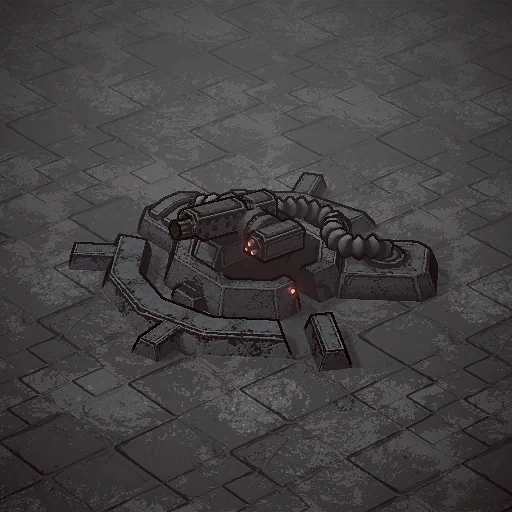
Weapons · 1
| Family | Fire cycle | Damage per second |
|---|---|---|
| Flamethrower | 0.65 s | 369.2 vs infantry · 76.9 vs vehicles · 30.8 vs buildings |
Damage per second = damage ÷ fire cycle, computed by the build script.
What it is
The Flamethrower turret costs 150 minerals and 100 energy. Its description identifies both its targets and its restriction: “The stream flamethrower constantly sets the area ablaze, causing significant damage to infantry and light vehicles. It has a limited field of view and aiming angle.” Build 23882143 records 1 400 base hit points and 50 armour. The linked weapon has separate aiming-angle limits, range and damage categories. Those settings support a directional defence role without proving that armour alone lets it survive every frontal attack. Read the fixed-defence and weapon guides when comparing a restricted fire arc with the approaches that need protection.
Where it comes from
The notes of 22 June 2026 state “mat fabricator and flame turret now disable when power is low”. This identifies a low-power behaviour change for the Flamethrower turret and Mat. Fabricator. It does not establish which building shuts down first, nor does it say those structures are removed from the battlefield. The turret’s linked energy component gives another reason to include power in the position’s plan. Read the economy guide alongside the turret’s aiming restrictions: a firing angle and an energy requirement constrain different parts of the defence.
How it is actually used
Calculated infantry DPS is 369.2, while the vehicle figure is 76.9. These are cycle-based comparisons before target protection, not guaranteed damage in a battle. The description’s limited aiming angle is the placement question: identify the approach you want covered and support the directions outside that arc. Check energy and visibility before relying on the position. A Bunker nearby may serve a different garrison role, but the combination is not a promise of an unbreakable line. The weapon and fixed-defence guides help compare those roles.
How to beat it
The mistake is assuming the turret covers every direction or always remains powered. Its 1 400 base hit points and 50 armour describe the building, not the cost of a particular frontal assault. Check its fire arc, range, visibility and neighbouring units before approaching. Moving outside the described angle is a possibility to assess, not proof that the whole enemy position cannot respond. For the defender, cover the omitted approaches and preserve power capacity. The fixed-defence and economy guides explain these separate constraints.
Values read from game files · version 23882143