Skip to content
Dust Front RTS Guide
Menu

Directional armour in the updated demo: Directional armour in the updated demo

Checked: — build 26104922

Compare the current front and rear armour on the vehicle’s page before choosing how to retreat. A directional-armour flag is not a third armour value. The earlier roster totals and examples below belong to the historical build.

Requirements / Minerals
800
Requirements / Gears
50
Requirements / Population
75
Requirements / Production time, seconds
90.0
Defence / Base hit points
1800
Defence / Extra capacity
60
Defence / Front armour
8
Defence / Side and rear armour
8
Defence / Directional armour flag
yes
Defence / Fire resistance value
1.0
Defence / Gas resistance value
1.0
Defence / Area resistance value
0.5
Defence / Total hit-point capacity
1860
Weapons / 1 / Weapon family
Projectile
Weapons / 1 / Range
81.37800598144531
Weapons / 1 / Range bonus
65.0
Weapons / 1 / Minimum range
22.0
Weapons / 1 / Reload, seconds
6.0
Weapons / 1 / Aiming time, seconds
0.30000001192092896
Weapons / 1 / Firing on the move
yes
Weapons / 1 / Damage / Infantry
50
Weapons / 1 / Damage / Vehicles
200
Weapons / 1 / Damage / Buildings
0
Weapons / 1 / Firing cycle, seconds
6.3
Weapons / 1 / Calculated damage per second / Infantry
7.9
Weapons / 1 / Calculated damage per second / Vehicles
31.7
Weapons / 1 / Calculated damage per second / Buildings
0.0

Some parameters and links remain uncertain. A missing value here does not establish absence of a game mechanic.

Unreadable objects and an unresolved ability link prevent treating this as a complete measurement of every mechanic.

The historical text is retained below — build 23882143. The following dates and values belong to their own source.

The historical edition is retained below — build 23882143

Directional armour: why you reverse instead of turning

Twenty-eight of the demo’s units carry the directional-armour flag. For those whose front armour is thicker than their rear armour, turning around to retreat swaps the strong face for the weak one — which is why the retreat often costs more than the fight did.

Dust Front gives many of its vehicles two armour values instead of one. The developer described the system publicly on 10 February 2026: “a differentiated armor system, represented by two conical shapes: one for the front arc and a combined one for the sides and rear.” Read that sentence carefully, because it settles a detail that several third-party databases get wrong: the sides are not a separate value. The sides share the rear number.

That matters, because the game files store the side value as a flag rather than a number. A database that prints the flag as a figure shows “1” in the side column — which reads as paper-thin flanks. It is not. A BMP with 60 at the front and 30 at the back has 30 on its flanks too.

How wide is the gap? Measured across the demo, build 23882143: 28 units carry directional armour, 30 carry a single uniform value. Among those with a gap, the widest are the Gorb Tank at 110 front against 50 rear, the Strong crawler at 140 against 90, the Flamethrower tank at 65 against 15, and the Bronenosets at 90 against 50. The Dreadnought and the BMP both sit at 60 against 30. So the penalty for showing your back runs from two-fifths of your protection at the mild end — the Tank “T-50B” and the Tank “Desolator”, both 50 against 30 — to more than three-quarters of it on the Flamethrower tank.

Three units are worth knowing about separately. The MLRS “Vortex”, the BREM and the Scorpio all carry the directional flag, yet their front and rear values are identical. In practice they behave like uniformly armoured units, and there is nothing to gain by angling them.

The practical rule follows directly. When a vehicle with a wide gap has to disengage, reverse; do not turn. The developer confirmed in the same February post that tracked and wheeled vehicles have a reverse gear, and named the reason: “to expose your stronger frontal armour, but also for more effective manoeuvres and retreats.” A tank that turns to run presents its 30 where its 60 was, for the whole duration of the turn, at the exact moment it is being shot at.

The mirror of that rule is how you attack. Against a unit with a wide gap, the fight is not about damage, it is about angle. Force it to rotate, flank it, or catch it while it is already turning. Against the three units above, none of that applies — hit them from wherever you like.

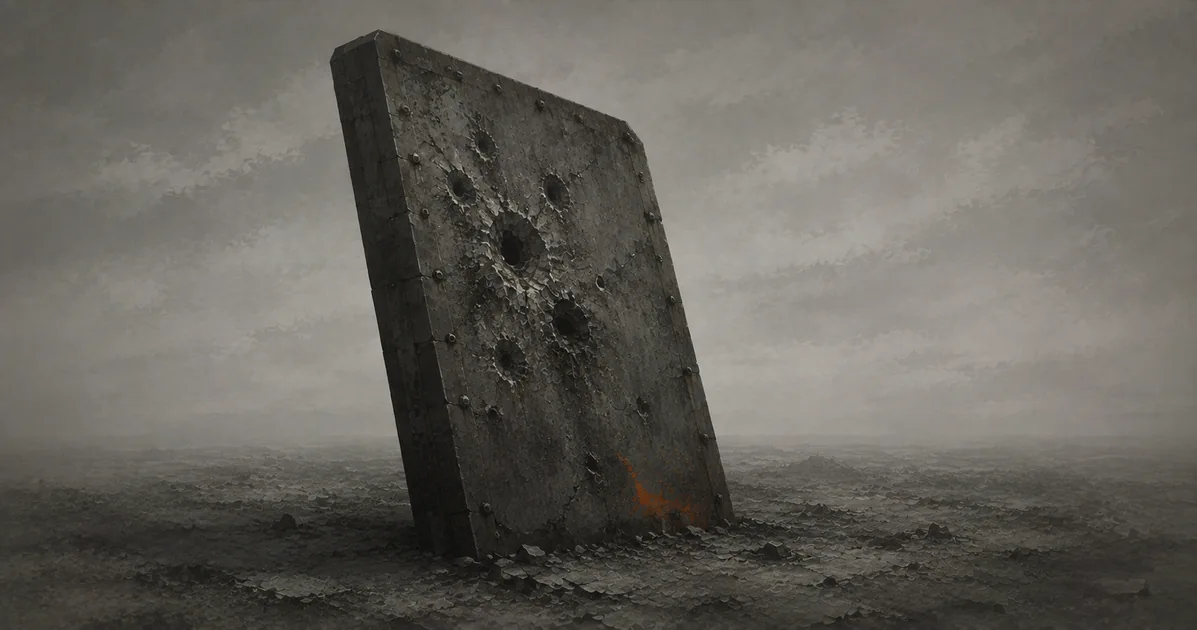
Original artwork for Directional armour in the updated demo — ⛔ an illustration made for this site, not a screenshot of the game

Directional armour in the updated demo

Twenty-eight of the demo’s units carry the directional-armour flag. For those whose front armour is thicker than their rear armour, turning around to retreat swaps the strong face for the weak one — which is why the retreat often costs more than the fight did.

Confirmed Updated · numbers from version 23882143

Original artwork made for this site — not a screenshot of the game

Dust Front gives many of its vehicles two armour values instead of one. The developer described the system publicly on 10 February 2026: “a differentiated armor system, represented by two conical shapes: one for the front arc and a combined one for the sides and rear.” Read that sentence carefully, because it settles a detail that several third-party databases get wrong: the sides are not a separate value. The sides share the rear number.

That matters, because the game files store the side value as a flag rather than a number. A database that prints the flag as a figure shows “1” in the side column — which reads as paper-thin flanks. It is not. A BMP with 60 at the front and 30 at the back has 30 on its flanks too.

How wide is the gap? Measured across the demo, build 23882143: 28 units carry directional armour, 30 carry a single uniform value. Among those with a gap, the widest are the Gorb Tank at 110 front against 50 rear, the Strong crawler at 140 against 90, the Flamethrower tank at 65 against 15, and the Bronenosets at 90 against 50. The Dreadnought and the BMP both sit at 60 against 30. So the penalty for showing your back runs from two-fifths of your protection at the mild end — the Tank “T-50B” and the Tank “Desolator”, both 50 against 30 — to more than three-quarters of it on the Flamethrower tank.

Three units are worth knowing about separately. The MLRS “Vortex”, the BREM and the Scorpio all carry the directional flag, yet their front and rear values are identical. In practice they behave like uniformly armoured units, and there is nothing to gain by angling them.

The practical rule follows directly. When a vehicle with a wide gap has to disengage, reverse; do not turn. The developer confirmed in the same February post that tracked and wheeled vehicles have a reverse gear, and named the reason: “to expose your stronger frontal armour, but also for more effective manoeuvres and retreats.” A tank that turns to run presents its 30 where its 60 was, for the whole duration of the turn, at the exact moment it is being shot at.

The mirror of that rule is how you attack. Against a unit with a wide gap, the fight is not about damage, it is about angle. Force it to rotate, flank it, or catch it while it is already turning. Against the three units above, none of that applies — hit them from wherever you like.

Values read from game files · version 23882143

← All guides