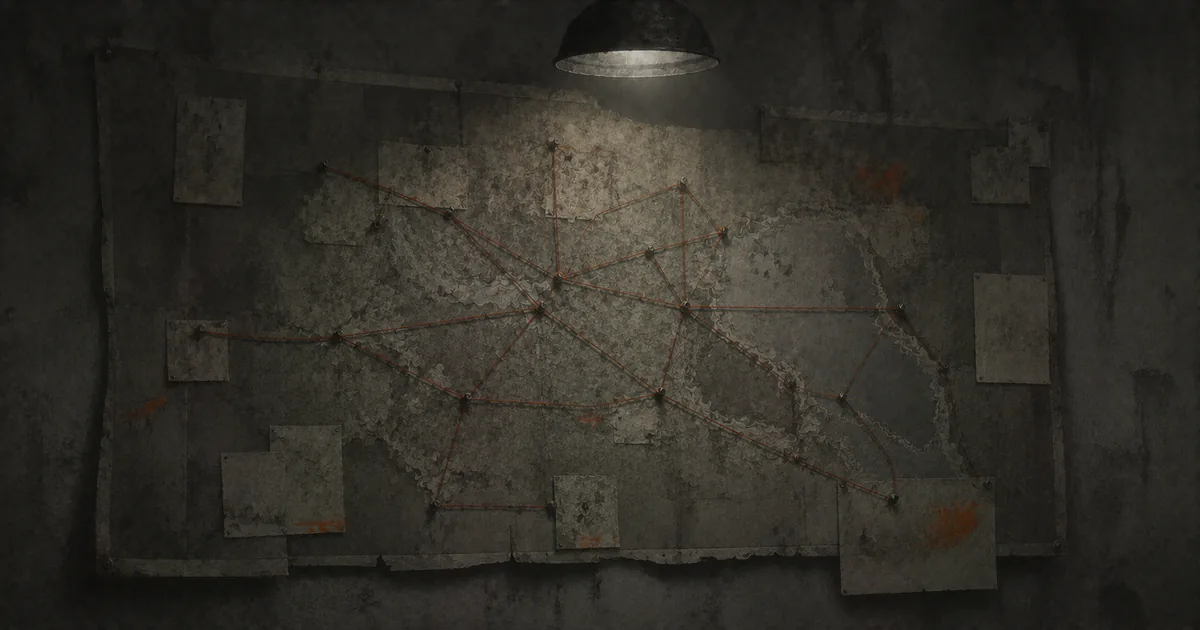
The demo is a set of real-time battles. The game it comes from is not, and the developer has been consistent about that since well before release. On 10 February 2026 he described the project as “a real-time strategy game with a global map. Roughly speaking: no more, no less”, and explained what that costs him: “by adding a global map and making the gameplay directly dependent on it, this essentially means creating two games in one.”
He was equally clear about what the campaign is for. “This is a systems-driven, not a story-linear, game. Its core lies in capturing territories, conquering the map, and methodical RTS battles.” And he gave a length: “this is not a large-scale project. A single campaign is designed for approximately 15 hours. My goal is to create a small but comprehensive game that fully meets my genre requirements.” Fifteen hours, one faction, on purpose.
None of that is playable in the demo. What is in the demo is the code — and, it turns out, rather more than code. Our first pass over the build found about fifteen classes under a global-map namespace and reported that reading class names tells you a notion exists without telling you anything about its values. ⛔ That was true of what we had read, not of what the build contains. Those classes carry display names, descriptions, prices, cooldowns and per-turn income, and we had simply never opened them. What follows is read from them.
Start with the money, because the campaign is a turn-based economy and the numbers are plain. A resource station yields 1 200 per turn and a fortified farm yields 500. A parts factory works the other way round: it spends 900 resources a turn to produce 70 parts, and its description adds that standing next to industry makes troops cheaper to raise in global-map cities. Regions are graded by industry — the ordinary region and the mutant region are rated 4 and hold up to 2 sub-regions, while a city is rated 3 and holds 1, and a facility is rated 3 and holds none.
Then the two things that end sectors rather than feed them. The siege fort lets you order a bombardment that reaches into tactical play — its own text limits it to adjacent territory, it costs 2 000, it strikes for 250, and it comes back every turn. The nuclear silo is described in the files as the Industrial Empire’s superweapon: it costs 2 000, recharges over 2 turns, and its ability text says the range is not limited and the chosen sector is destroyed. ⭐ The build also records what a destroyed sector becomes — a ruin that can then be captured. ⚠️ None of this is reachable in the demo you can download.
Command centres are the throttle on the whole campaign, and the rule is a single sentence in the file: each headquarters grants one order to attack an enemy sector per turn. The Empire version adds one clause the other two do not — it raises the maximum army you may commit to an attack by 50. Three capitals are recorded, for the Empire, the robots and the mutants, each fielding between 100 and 150. ⭐ There is no capital for the Rebels, which fits the way the developer described them: the faction of the grey zones. An air base entry exists too, and its whole description is that it allows aviation to be used.
⛔ Two honest limits on everything above. First, these strings are stored as raw Russian inside the configuration files rather than through the game’s own translation table, so what you read here is our translation of the developer’s working text — not a line any English player has been shown. Second, a value in a demo build is a value in a demo build: it says what the campaign layer does today, ⛔ not what will ship. We are reporting what is in the file you can download, and we date it.
One find is worth reporting anyway, because it is not in any announcement. The build also carries roughly ten classes under a map-editor namespace. A map editor has never been mentioned by the developer — not in the demo launch post, not in the February compilation, not in the devlog. We are not claiming the full game will ship one. We are reporting that the code for one is in the demo you can download today, and that nobody has said a word about it.
This is also the honest place to say what we cannot tell you. There is no release date — the developer has explained at length why he will not give one. There is no multiplayer, and there will not be: “The project doesn’t need it… I have no intention of building a multiplayer community.” And there is one campaign, for the Empire, for the reasons quoted above.
Quotations from the announcements of 10 February and 15 June 2026, archived in this repository; campaign values read from build 23882143 and produced by script.
Values read from game files · version 23882143