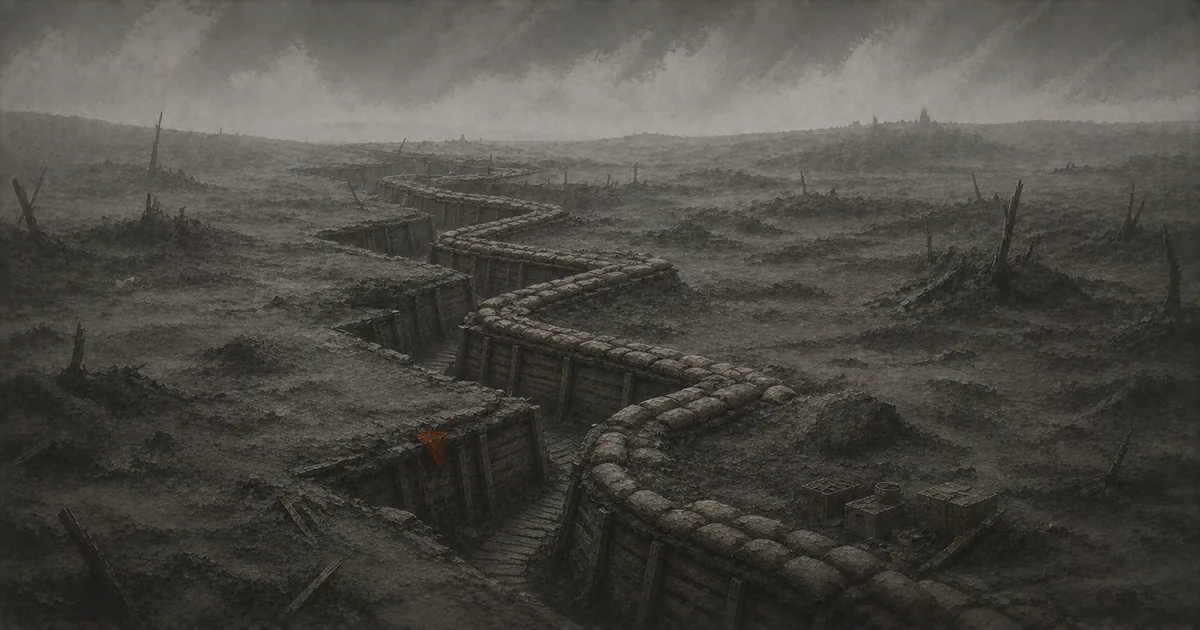
People asked about this before the demo shipped, and the answer came in the launch announcement of 15 June 2026: “Yes, you will be able to build trenches and other defensive structures in this demo.” The files show what that means in practice, and there is a pattern running through all of it.
Start with the trench, because the files are blunt about it. Its own in-game description reads “The cheapest and fastest-to-build defensive structure compared to others.” It costs 10 minerals and six seconds — the lowest price and the fastest build time of any building in the demo — and it carries 200 hit points with a 1 000-point reserve, 25 armour on every face, and an area resistance of 0.6.
Put those numbers beside the alternatives and the gap is not close. A trench gives you 1 200 total hit points for 10 minerals. The Bunker gives you 1 150 for 120, and the flamethrower turret 1 450 for 150 plus 100 energy. Nothing else in the demo defends a position at that price — and the 0.6 area resistance is the part that matters most, because it is resistance to exactly the splash weapons an attacker brings to clear a position.
The Bunker is the next step up, and it buys something a trench cannot. It costs 120 minerals, takes twelve seconds, and — in the developer’s own upgrade text — “Unlike turrets, it doesn’t require electricity.” That distinguishes it from powered turrets. The catalogue totals of 3 020 energy consumption and 1 340 production combine all factions and do not describe the balance of one base. It holds 1 100 hit points behind 30 armour, and its description says it “can house infantry units” and “can also restore infantry health with appropriate upgrades.” Cheap, tough, powerless and a hospital.
The turrets cost more and cost power. The anti-tank AK-125 is 200 minerals and 150 energy for 700 hit points; the flamethrower turret is 150 minerals and 100 energy for 1 400 hit points behind 50 armour, which makes it the toughest defensive structure the Empire can build. Its own description is honest about the trade: it “has a limited field of view and aiming angle.”
Now the pattern, and it is the reason this page exists. The fortification upgrades described here trade mobility for protection, and the files say so in plain words. The trench upgrade at 120 minerals and six seconds turns a trench into “a small bunker.” The barricade upgrade at 70 minerals and five seconds increases survivability, and “The ability to move the turret (if any) is lost.” Even the mobile AK-30 turret follows it: “They can move and dig in. Once dug in, the turret loses its ability to move.”
These fortification upgrades trade mobility for protection.
That has a consequence for how you use a defensive line, and it is not the obvious one. A dug-in position is not a wall you build once. It is a decision about where the fight will be, taken before the fight, and it cannot be revised. The developer’s third tip for new players is the same idea from the other end: “Control the frontline. If you’re holding too narrow a front, the enemy can easily strike you with their entire army.” A narrow dug-in line is exactly the shape he is warning you about.
The doctrines are where static defence stops being cheap. The three turret doctrines cost 1 000 minerals each, and the Bunkers doctrine the same — four separate purchases at 1 000 apiece, when the two most expensive upgrades in the game cost 3 000 each. The trench needs none of them.
Quotations from the announcement of 15 June 2026 and from the in-game descriptions of build 23882143.
There is one number the description of the Bunker never gives you, and it is the one that decides whether digging in is worth the walk. The files record how many infantry each position holds: 5 in the Bunker, 2 in the Barracks, and exactly 1 in a trench. ⭐ A trench is a firing position for one squad, not a fortress — which is why the right comparison is not one trench against one bunker but a line of trenches against a bunker, and at 10 minerals each you can dig a great many. Heavy cover also takes 1. Every one of these lets its occupants shoot out, and the Bunker adds 3 to your vision while it is manned, the trench 1.
⭐ The same field also settles a question about the two Empire transports, and the answer is the opposite of what their price suggests. The BMP carries 3 and the BTR carries 2 — but ⛔ the BMP is the one vehicle in the demo whose passengers cannot fire from inside. It is a delivery vehicle; the BTR is a fighting position that moves. If you are pushing infantry onto a contested position, that distinction is the whole decision.
Values read from game files · version 23882143