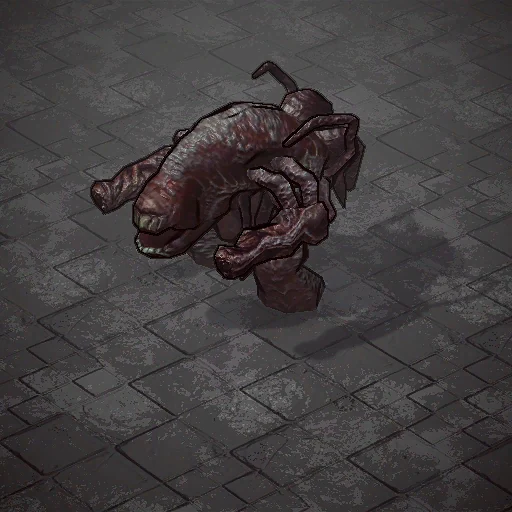
Weapons · 4
| Family | Fire cycle | Damage per second |
|---|---|---|
| Projectile | 2.8 s | 107.1 vs infantry · 67.9 vs vehicles · 53.6 vs buildings |
| Projectile | 2.5 s | 120 vs infantry · 76 vs vehicles · 60 vs buildings |
| Projectile | 11.2 s | 0 vs infantry · 0 vs vehicles · 0 vs buildings |
| Machine gun | 1 s | 30 vs infantry · 10 vs vehicles · 15 vs buildings |
Damage per second = damage ÷ fire cycle, computed by the build script.
What it is
Cerberus costs 400 minerals and 50 population, with a sixty-second production time. Its description states “An armored assault mutant with strong bones. Easily regenerates health during combat. It is immobile and has two artillery cannons.” In build 23882143, its health component records 1 400 base hit points, reserve capacity 300 and uniform armour 55. The Strong crawler instead has 140 front armour and 90 at the sides and rear. Those fields distinguish protection layouts, not a universal ranking of survivability. The description’s immobility claim also needs care: a movement component is present in the extracted data.
Where it comes from
The developer’s announcement of 10 February 2026 describes Mutant corpse recycling into flies and Worms. That faction mechanic does not by itself explain Cerberus regeneration or make it a replacement for the Empire’s BREM. Its own description mentions recovery during combat, and an attached projectile points to a healing-area object with a healing component. This supports a distinct recovery mechanism, while leaving its complete targeting and timing unmeasured. Neither the announcement nor that link guarantees victory in every prolonged exchange.
How it is actually used
The two artillery records give calculated infantry rates of approximately 120 and 107, and vehicle rates of approximately 76 and 68. These are individual catalogue calculations, not a measured combined volley. Another gun and a healing-area projectile are also linked, so dismissing every other component would miss part of the unit. Its area coefficient 0.8 cannot establish a damage reduction without the game’s formula. Choose a firing position that considers the artillery’s minimum range and supporting units; regeneration does not make exposed deployment safe.
How to beat it
At 400 minerals and 50 population, Cerberus is a substantial commitment. The word immobile in its description conflicts with a recorded movement component, so it is unsafe to assume it can never follow a retreat. Recovery during combat also does not prove that slow exchanges always favour it. Its fire coefficient 0.65 is a parameter, not a guarantee that flame fails. Assess its actual firing position, reach and nearby support before committing; moving around its coverage is an option when the objective allows it, rather than an absolute rule to attack or ignore it.
Values read from game files · version 23882143